How many yards of concrete are in a truck for a Mecklenburg County job? A standard ready-mix truck holds 8 to 10 cubic yards, though the exact number that shows up at your curb depends on the plant, the mix, and the roads leading to your site. We've staged pours on tight infill lots in Dilworth and wide-open driveways in Huntersville, and the textbook answer and the real-world one aren't always the same.
How Many Yards of Concrete Fit in a Standard Truck?
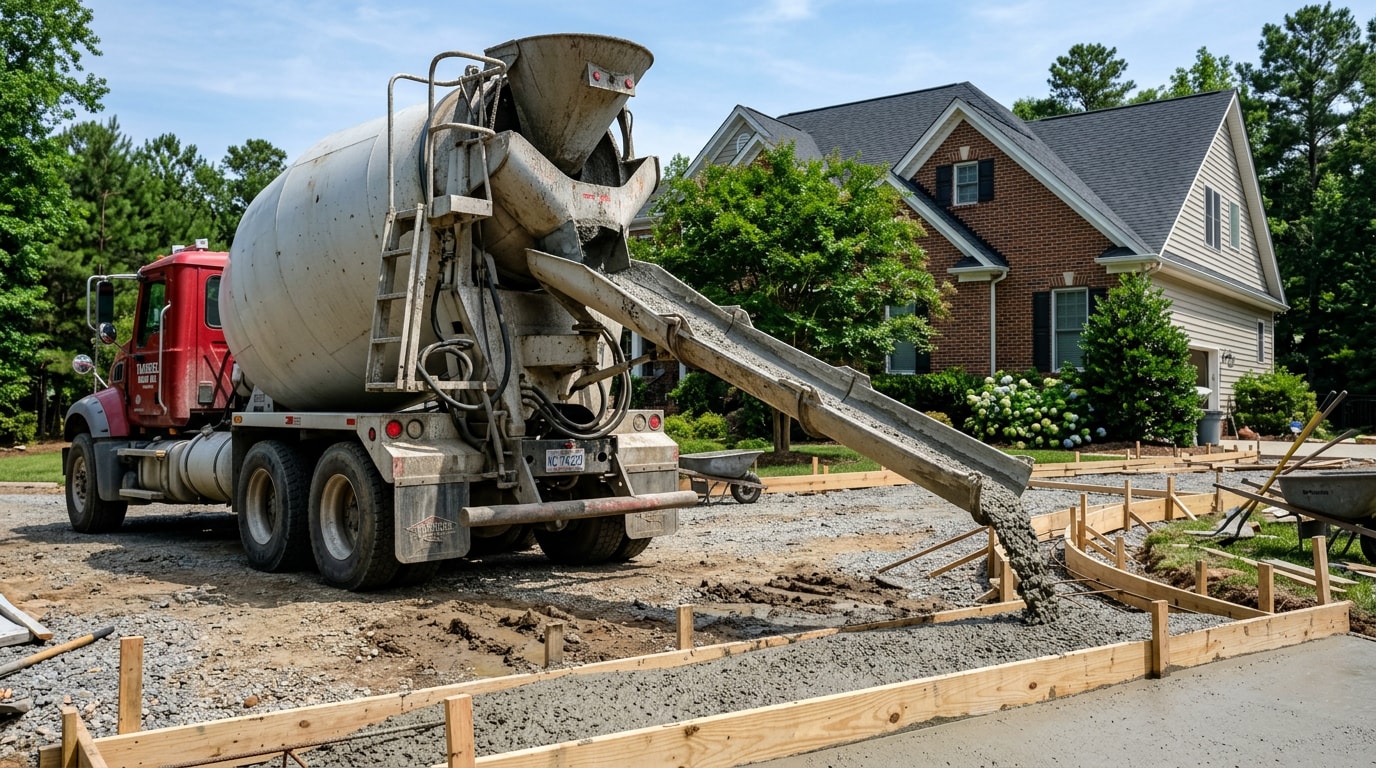
A standard rear or front discharge mixer carries 8 to 10 cubic yards. That's the size you'll see most often on driveway pours, patios, and residential slabs around Charlotte and the rest of Mecklenburg County.
Concrete is sold by volume, in cubic yards, and the capacity of truck mixers varies between 8 to 12 cubic yards (5 to 9 m³) , according to the National Ready Mixed Concrete Association. That upper range covers the larger commercial mixers you'll see on bigger commercial pours, not the typical residential delivery.
| Truck Type | Typical Capacity | Best For |
|---|---|---|
| Mini / volumetric mixer | Up to 2 cubic yards | Tight-access lots, small repairs, fence posts |
| Standard mixer truck | 8 to 10 cubic yards | Driveways, patios, residential foundations |
| Large commercial mixer | Up to 12 cubic yards | Commercial slabs, large-scale pours |
Types of Concrete Trucks Used Around Mecklenburg County
Not every mixer on the road carries the same load. The truck that fits depends on your site's access, lot size, and how much concrete the job actually needs.
Standard Concrete Trucks
These are the mixers most homeowners see pull up for driveway and patio work. They typically hold 8 to 10 cubic yards and handle the bulk of residential slab pours across Charlotte, Matthews, and Pineville.
Larger Commercial Mixers
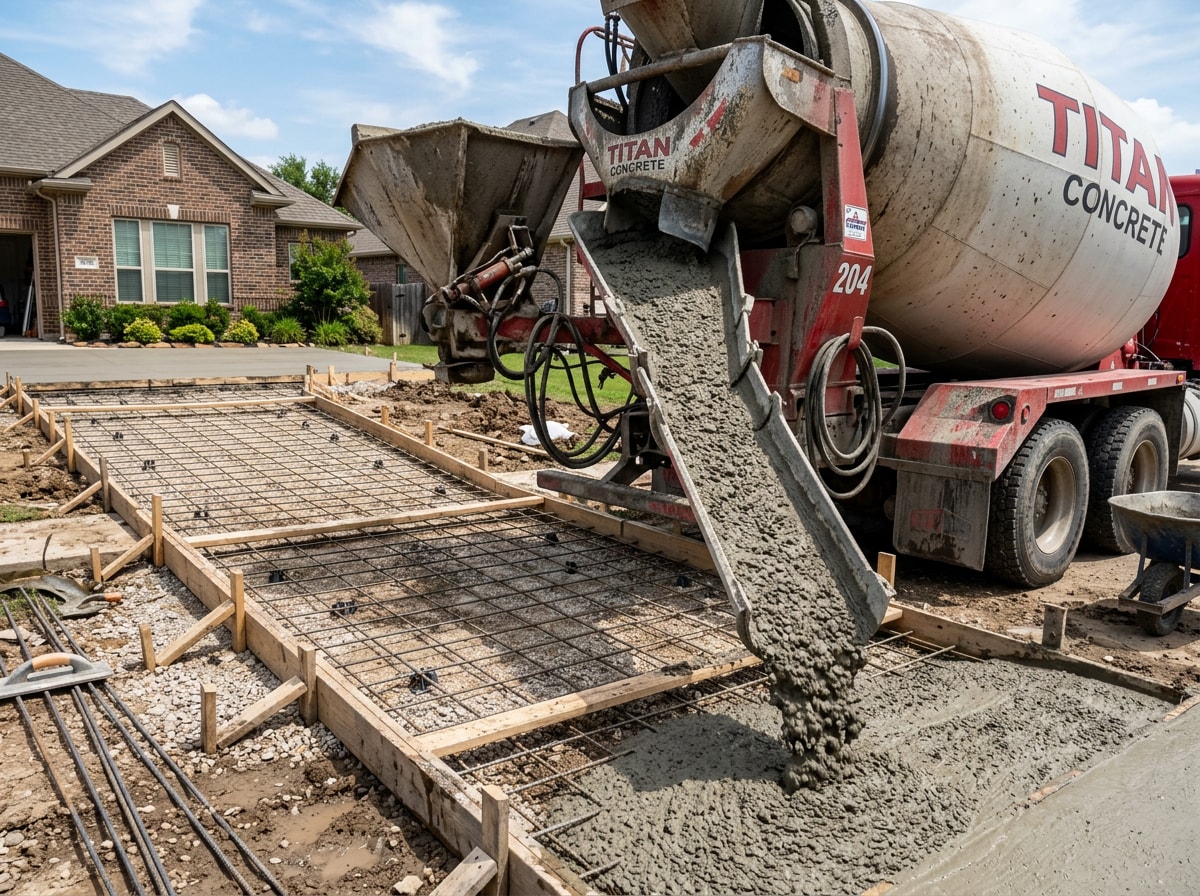
Crews bring in bigger mixers, carrying up to 12 cubic yards, for commercial slabs and large-scale pours where fewer trips mean faster placement. These trucks need more turning radius and a firmer approach, which matters on older streets with tighter curb cuts.
Mini and Volumetric Mixers
Volumetric trucks mix concrete on-site in variable amounts, which is useful for tight-access lots common in older Charlotte neighborhoods like NoDa and Plaza Midwood. Mini mixers that hold up to 2 cubic yards are the smallest practical option and the easiest to maneuver into cramped backyards.
What Actually Limits How Much a Truck Delivers
A "10-yard truck" is a ceiling, not a guarantee. Every truck has a maximum weight limit, and so do the roads it drives on.
Federal weight standards cap commercial vehicles at 80,000 pounds gross vehicle weight, 20,000 pounds on a single axle, and 34,000 pounds on a tandem axle, and a bridge weight formula also applies to commercial vehicles in determining their compliance with these limits . That formula weighs axle spacing against total load, not just the number on the door. A fully loaded 10-yard truck can push close to those limits once you account for the weight of the drum, the chassis, and the water tank, so plants often send trucks out a yard or two light to stay compliant on routes with weight-restricted bridges or older pavement.
Site conditions add another layer. Narrow driveways, low tree canopy, and sharp turns on older lots can force a driver to park farther from the forms, which slows the pour and sometimes means hand-wheeling the last few yards. We've had jobs where the quoted 9-yard load had to come in on a smaller truck simply because the only approach was a single-lane alley.
Concrete Truck Costs and Short-Load Fees
Pricing scales with volume, so knowing your yardage before you call a plant keeps your budget accurate. A standard truck typically covers 8 to 10 cubic yards in one trip; anything beyond that usually means a second truck.
What Is a Short-Load Fee?
Order less than a full truck, usually under 8 to 10 yards depending on the plant, and you'll likely pay a short-load fee. The charge exists because the driver makes the same trip and burns the same fuel whether the drum is full or half-empty.
- Ask your supplier for their exact short-load threshold before ordering.
- Combining smaller pours into a single order can avoid the fee entirely.
- Volumetric mixers sometimes skip the minimum altogether since they batch on-site.
For a broader look at what local ready-mix and related materials run per yard, our cement pricing guide for the Greater Charlotte Area breaks down current cost ranges by mix type.
How to Calculate How Much Concrete You Need
Use this formula: Length (ft) × Width (ft) × Depth (ft) ÷ 27 = cubic yards needed.
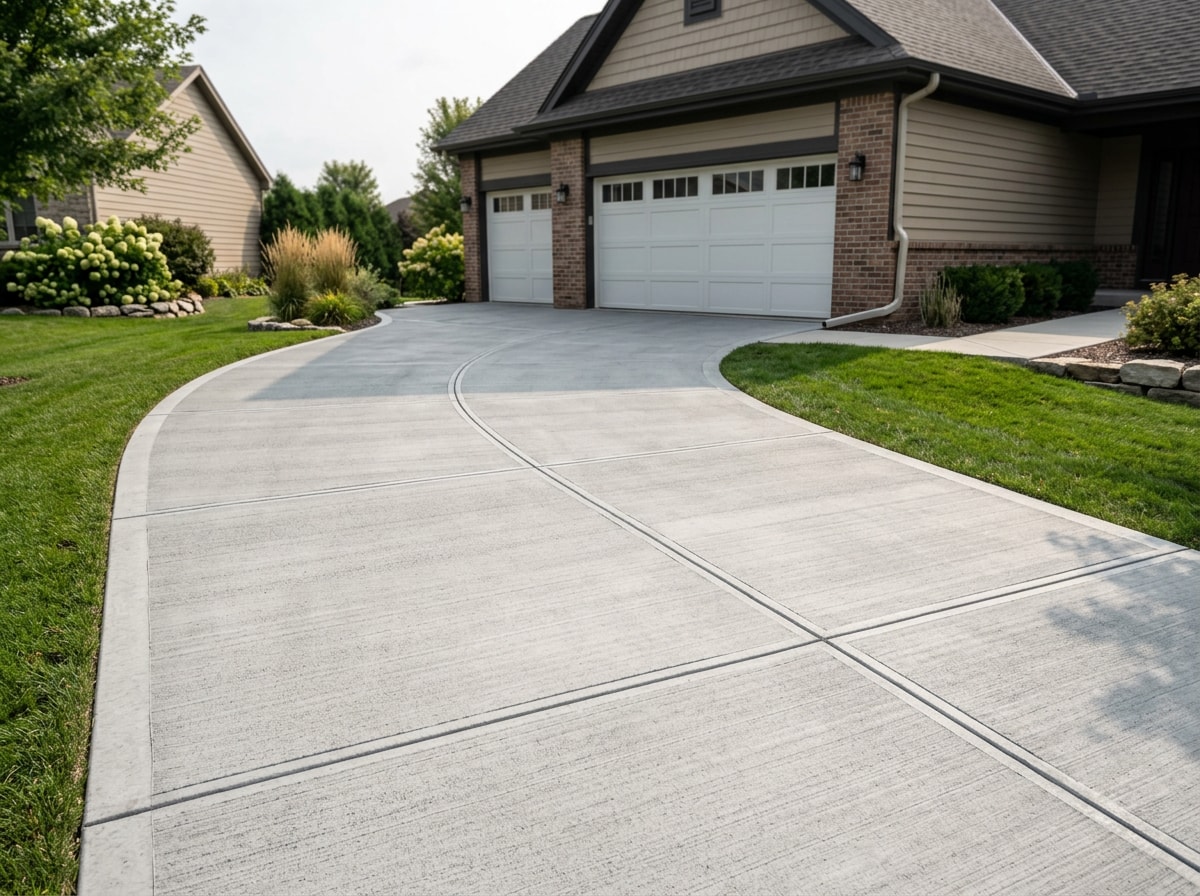
For a 16 ft by 30 ft driveway at a 4-inch depth (0.33 ft): 16 × 30 × 0.33 ÷ 27 equals roughly 5.9 cubic yards. That's close to a single truck's capacity, so it's worth rounding up slightly rather than ordering a tight short load and risking a second trip mid-pour.
Most contractors also build in a small buffer, typically 5 to 10 percent over the calculated volume, to cover spillage, form loss, and uneven subgrade. On a 6-yard job, that's about a third to half a yard of margin.
Mecklenburg County Driveway Specs Worth Knowing
If your pour connects to a public right-of-way, local specifications matter as much as the truck size. Mecklenburg-area driveway permit guidance calls for a concrete cross section of 6 inches thick at 3,600 psi minimum where the driveway ties into the road. That thickness and strength requirement changes your total yardage, since a 6-inch slab needs roughly 50 percent more concrete than a standard 4-inch patio pour.
Check with your local permitting office before you order concrete, since requirements can vary slightly between Charlotte, Huntersville, Matthews, and the surrounding towns within the county.
Choosing the Right Truck for Your Project
The right truck comes down to three things: total volume, site access, and whether the job connects to a county or state road. A calculator helps with the math, but matching that number to the correct truck size and a crew that knows the local permit rules is what keeps a pour on schedule.
We handle that matching on every job we take on in Mecklenburg County and the wider Charlotte metro. You can see examples of recent driveway and site work on our projects page, or start with our residential paving services if your project includes base work before the pour. Request an estimate and we'll tell you exactly how many yards and what truck size your job needs before the crew ever shows up.
FAQ
What Is a Full Truck of Concrete?
A full truck of concrete, also called a ready-mix or cement mixer truck, typically holds 8 to 10 cubic yards. Larger commercial mixers can carry up to 12 cubic yards.
Can a Concrete Truck Deliver a Partial Load?
Yes. Trucks can deliver partial loads, but you'll usually pay a short-load or trip fee since the driver still makes the full trip regardless of how much concrete is on board.
How Many Yards of Concrete Fit in a Standard Truck?
A standard rear or front discharge truck carries 8 to 10 yards, the typical size for driveways, patios, and residential foundations across Mecklenburg County.
How Much Does a Full Truck of Concrete Cost?
Cost scales with cubic yardage, mix strength, and delivery distance. Specialty mixes, like high-early-strength or fiber-reinforced concrete, cost more per yard than standard mixes.
Do I Need a Permit to Pour a New Driveway in Mecklenburg County?
It depends on whether you're changing the access point onto a public road. Replacing an existing driveway in the same footprint often doesn't require a new permit, but any change to width, location, or a connection onto a state-maintained road usually does. Confirm with your local permitting office before the truck is scheduled.
How Much Extra Concrete Should I Order?
Build in a 5 to 10 percent buffer above your calculated volume to cover spillage, form loss, and uneven subgrade. It's cheaper than paying for a second short-load delivery mid-pour.
About the Author
This guide was written by the project team at Ward Contracting Inc., a Charlotte-area paving and site contractor that coordinates concrete and material deliveries on driveway, parking lot, and retaining wall jobs throughout Mecklenburg County. For project-specific truck sizing or a materials estimate, contact us or visit the Ward Contracting Inc. homepage for more on our services.