Concrete screws for Mecklenburg County, NC projects only work if the size, bit, and technique all line up. Get any one of those wrong and the threads strip, the screw spins free, and you're left drilling a second hole next to the first. This guide covers exact sizing, step-by-step installation, how concrete screws stack up against wedge anchors, and the point where a DIY anchor job should become a call to a licensed concrete contractor.
What Is a Concrete Screw and How Does It Work?
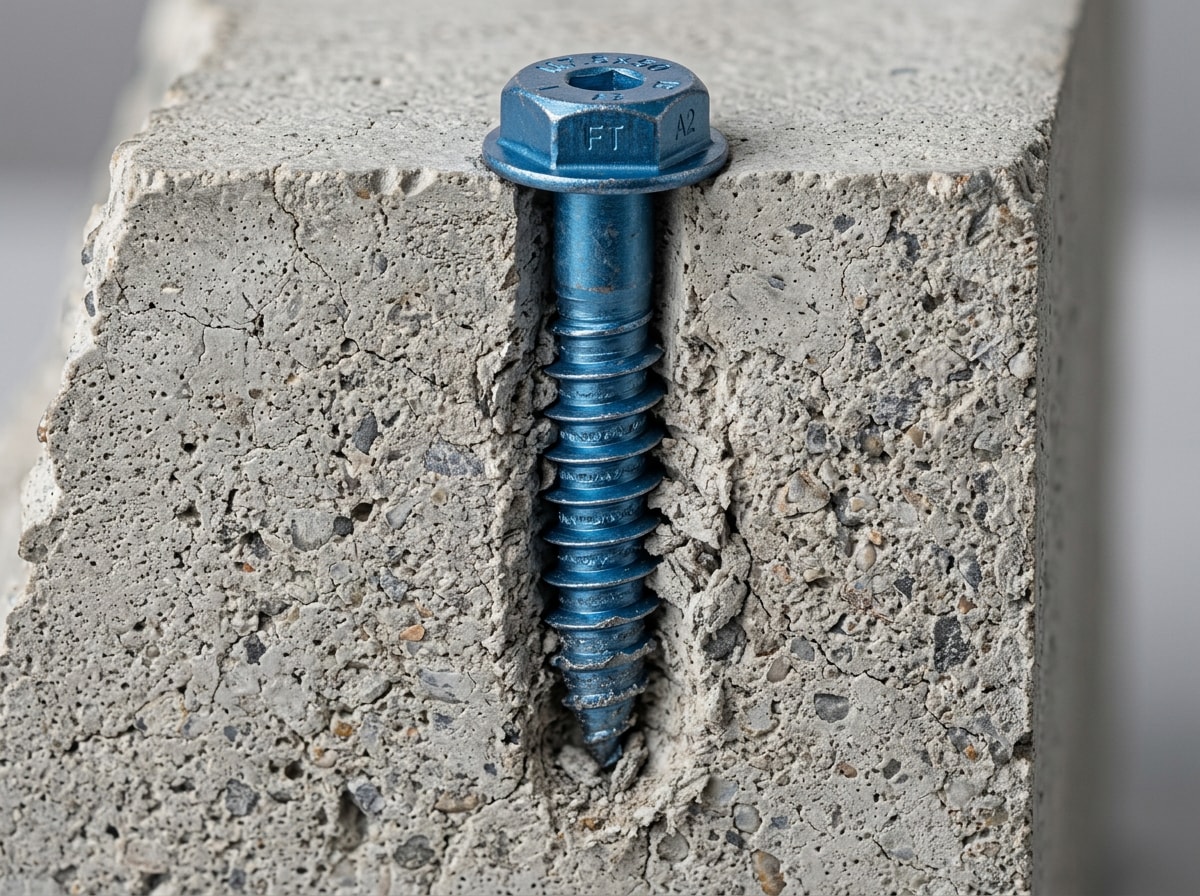
A concrete screw is a hardened steel fastener with threads that cut directly into a pre-drilled hole in masonry. There's no expanding sleeve, no epoxy, and no separate anchor body required. This self-tapping design is what separates it from a wedge or sleeve anchor, which grips a hole through mechanical expansion instead.
Because the screw cuts its own mating threads as it's driven, hole size and depth matter more here than with almost any other fastener type. Concrete screws work in poured concrete, CMU block, and brick, though holding power varies by substrate density. A screw driven into solid poured concrete will generally outperform the same screw in a softer block wall.
What Are Tapcon-Style Concrete Screws?
"Tapcon" is a brand name that has become shorthand for the entire concrete screw category, similar to how certain brand names turn into everyday generic terms. Not every concrete screw sold at a hardware store is an actual Tapcon, even though the name gets used loosely on job sites.
Tapcon-style screws commonly ship in a corrosion-resistant blue coating, along with stainless finish options for outdoor work. Head styles include hex head for use with a nut driver or socket, Phillips flat head for flush-mount applications, and star drive, which resists cam-out better under an impact driver.
Concrete Screw Sizes, Drill Bit & Hole Depth Chart
Picking the right screw diameter is only half the job. The drill bit and hole depth have to match it exactly, or the threads won't cut cleanly and holding power drops. A 3/16″ screw takes a 5/32″ bit, and drilling it at 3/16″ instead leaves nothing for the threads to bite into.
The table below covers the small-diameter screws used for trim and brackets, plus the larger sizes used in heavier framing connections.
| Screw Diameter | Drill Bit Size | Min. Embedment | Typical Hole Depth |
|---|---|---|---|
| 3/16" | 5/32" | 1" | 1 1/4" |
| 1/4" | 3/16" | 1" | 1 1/4" |
| 3/8" | 5/16" | 1 1/2" | 2 1/2" |
| 1/2" | 3/8" | 2" | 3" |
The 3/16” and 1/4” holes must be drilled 1/4” deeper than the screw will penetrate, while the 3/8”, 1/2”, 5/8”, and 3/4” holes must be drilled 1” deeper. That extra depth matters because drilled dust collects at the bottom of the hole and needs somewhere to go besides under the screw tip.
These figures vary slightly by manufacturer, so always confirm against the current ICC-ES evaluation report for the specific product before drilling, especially on larger-diameter fasteners.
Step-by-Step: How to Install Concrete Screws
Installing concrete screws correctly is less about brute force and more about following the sequence in order. Skipping a step, especially dust removal, is the most common reason an otherwise correctly sized screw won't hold.
- Mark the location and confirm edge distance.
Manufacturer charts often call for roughly 2 inches of edge distance on a 3/16-inch screw, increasing to about 2 1/4 inches on a 1/4-inch heavy-duty screw, with about 3 inches of spacing between fasteners.
- Select the correct carbide-tipped bit matching your screw diameter from the chart above.
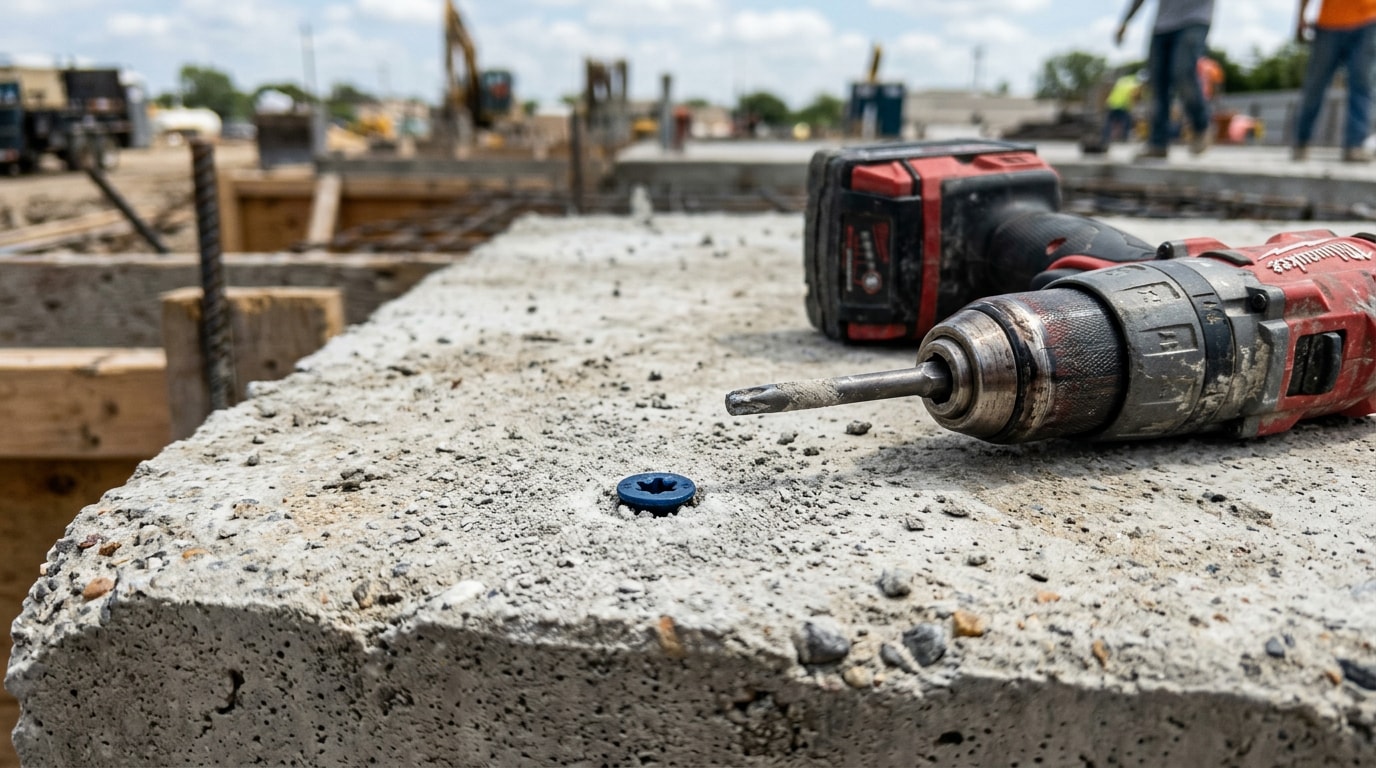
- Drill the pilot hole with a hammer drill set to hammer mode, holding the bit perpendicular and going to the full depth noted above.
- Clear the dust completely. A shop vacuum, hand pump, or a few sharp taps and a blow-out all work. Leftover dust is a top cause of a screw that spins without biting.
- Drive the screw with a hammer drill or impact driver on a low-to-medium torque setting until the head sits snug. Stop as soon as it's snug; don't keep cranking.
Drilling into concrete, brick, and masonry generates fine silica dust. Crystalline silica is a common mineral found in construction materials such as sand, stone, concrete, brick, and mortar, and OSHA maintains a construction silica dust standard covering exposure controls for drilling and cutting tasks. Safety glasses, a dust mask, and a vacuum attachment on the drill matter more than most DIYers expect.
For larger fastening work tied to a bigger concrete project, it often makes sense to loop in a concrete contractor rather than handling it piecemeal.
Concrete Screws vs. Wedge Anchors: Side-by-Side Comparison
Concrete screws and wedge anchors solve similar problems in different ways. A concrete screw cuts its own threads into the hole; a wedge anchor drives a tapered pin into a sleeve, forcing the sleeve to expand and lock mechanically against the sides of the hole.
| Feature | Concrete Screw | Wedge Anchor |
|---|---|---|
| Grip method | Cuts its own threads | Mechanical expansion sleeve |
| Typical use | Trim, brackets, light fixtures | Structural and load-bearing connections |
| Removable | Yes, with reduced reuse strength | Generally not without damaging the hole |
| Install speed | Fast, single-tool process | Slower, requires setting/torque step |
| Inspector preference | Light-duty, non-structural | Listed/engineered structural loads |
That mechanical grip is also why wedge anchors generally carry higher rated loads than a similarly sized concrete screw, though the exact numbers vary by brand, embedment depth, edge distance, and whether the concrete is cracked or uncracked. Current load data is published in each product's ICC-ES evaluation report, the code-compliance listing manufacturers use for anchors evaluated for use in cracked and uncracked concrete.
That gap is exactly why inspectors typically require listed expansion anchors or engineer-specified anchor bolts for load-bearing connections, reserving light-duty concrete screws for furring strips, trim, brackets, and non-structural fastening.
Decision rule: if the connection supports a structure, a deck ledger, or anything where failure creates a safety risk, default to a wedge anchor or engineer-specified anchor bolt. If it's a bracket, sign, or light fixture under a few hundred pounds, a properly sized concrete screw is usually the simpler, faster call.
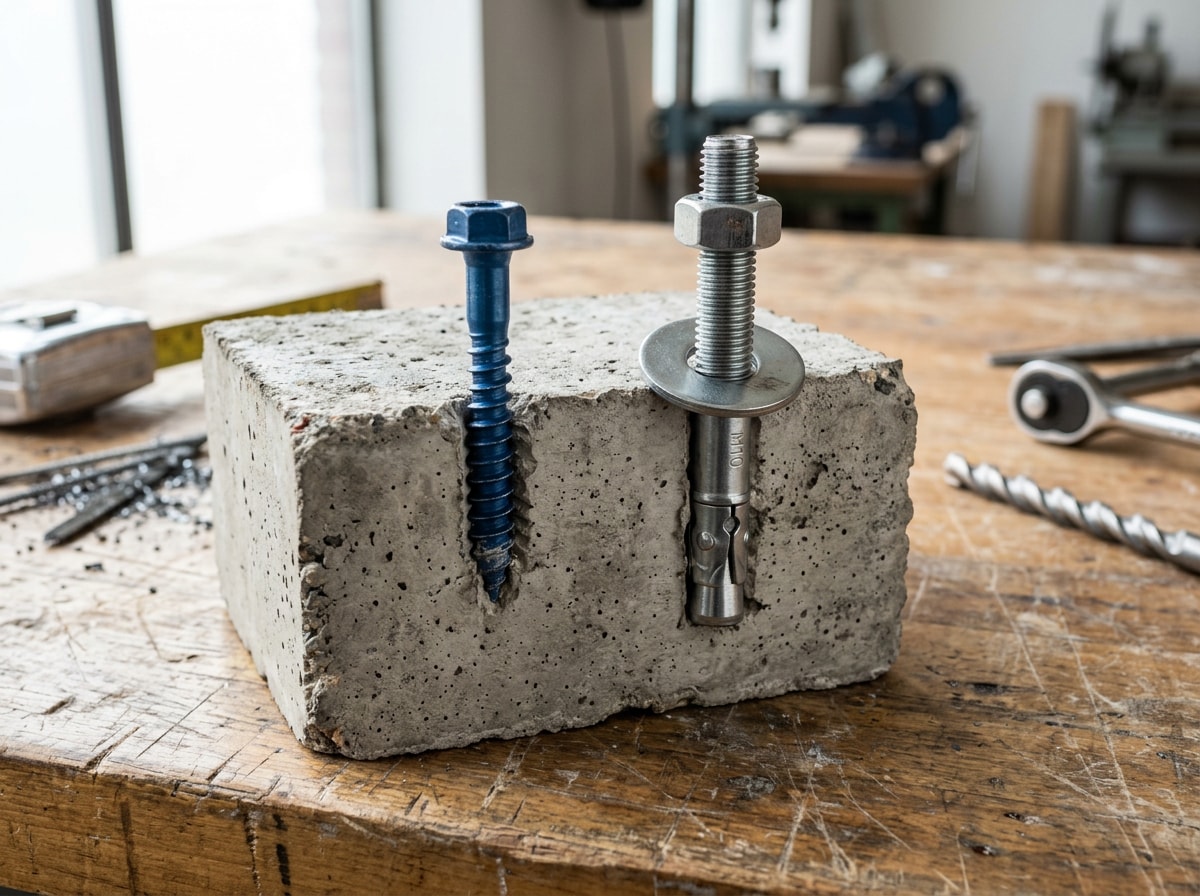
Fastening Best Practices & Common Mistakes to Avoid
Good technique and the right hardware only go so far if a few avoidable habits undo the work. The mistakes below account for most of the loose or failed concrete screw installations seen in the field.
Common Mistakes That Cause Screw Failure
- Over-torquing. Once the cut threads strip from being driven past snug, the screw loses its grip permanently. There's no fix short of stepping up to a larger-diameter screw and a fresh hole.
- Wrong bit size. A bit even slightly off from spec leaves the hole either too tight to thread cleanly or too loose to bite at all.
- Skipping dust removal. Debris packed under the screw tip blocks full embedment every time.
- Drilling into bad concrete. Driving into noticeably soft, crumbling, or visibly deteriorated concrete won't let the threads form correctly, no matter how carefully everything else is done.
Mecklenburg County Climate, Permits & When to Call a Pro
Light fastening work, like shelving, trim, and small fixtures, is reasonable DIY territory for most homeowners. Permitted structural connections, load-bearing attachments, and anything going into questionable concrete cross into territory where a licensed professional should be involved.
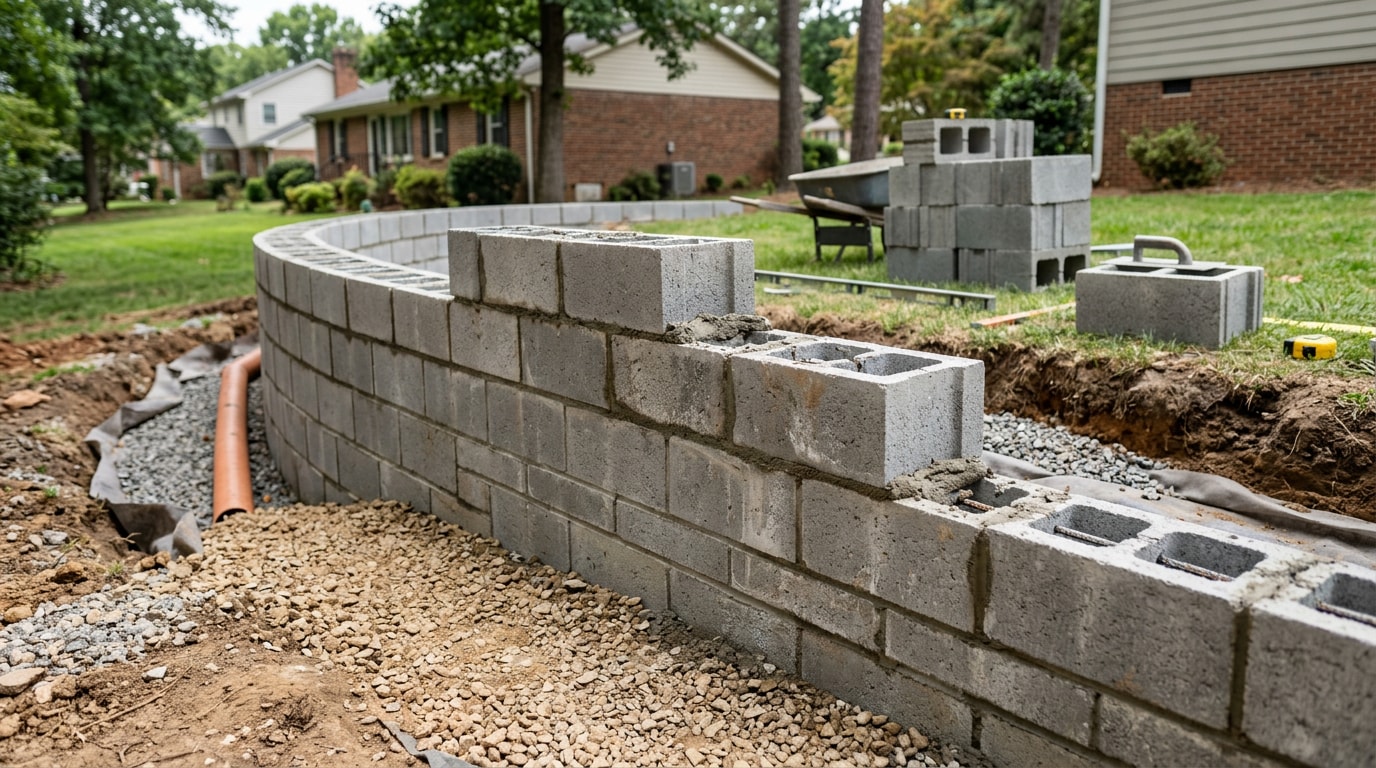
A Mecklenburg County retaining wall permit is required when the wall supports five feet or more of fill, and the submittal needs sealed drawings, a site plan, and a structural load sheet. If you're unsure whether your project needs a permit before drilling or pouring, the county's Code Info & Resource Center is the official place to check before starting work.
Climate matters too. NOAA's official 1991–2020 climate normals for the Charlotte area show average relative humidity running from the high 60s to low 80s percent across the year. That kind of year-round humidity, confirmed through NOAA's U.S. Climate Normals program, accelerates corrosion on standard carbon-steel fasteners. For outdoor, pool-deck, or lakefront installations, stainless steel or hot-dip galvanized concrete screws are worth the extra upfront cost.
Our crews at Ward Contracting Inc. run into the same pattern on jobsites across the county: a homeowner's DIY anchor holds fine for a season, then starts working loose once that humidity swing hits the fastener year after year. For bigger projects, a new patio, a structural footing, or a retaining wall with embedded hardware, setting anchor bolts before the concrete is poured is often simpler and stronger than drilling after the fact. If you're estimating a pour for a footing or slab, our guide on how many yards of concrete fit in a truck for Mecklenburg County jobs is a useful next read.
You can also see completed anchored-slab and footing work in our project gallery. If you're unsure which category your project falls into, request an estimate and we'll help you figure out whether it's a drill-it-yourself job or one that needs a contractor on site first.
FAQ
These are the questions homeowners and contractors across Mecklenburg County and the wider Charlotte metro area ask most often, both before and after installing concrete screws.
What Is the Difference Between a Concrete Screw and a Wedge Anchor?
A concrete screw cuts its own threads into a pre-drilled hole and suits light-to-medium duty fastening, while a wedge anchor expands a sleeve against the hole walls for a mechanical grip rated for heavier, often structural loads. Choose based on the load the connection needs to carry, not just convenience.
How Deep Should I Drill for a Concrete Screw?
Standard small-diameter concrete screws need about 1 inch of embedment, increasing to 1 1/2 to 2 inches for 3/8-inch and 1/2-inch screws. Drill the hole 1/4 inch deeper for small screws and a full inch deeper for larger ones, so loose dust has somewhere to settle instead of blocking the screw tip.
Do I Need a Hammer Drill to Install Concrete Screws?
Yes. Concrete screws require a hammer drill or rotary hammer set to hammer mode paired with a carbide-tipped masonry bit. A standard twist bit in a regular drill won't cut into concrete, brick, or block.
Are Concrete Screws or Wedge Anchors Better for Outdoor Use in Mecklenburg County?
For outdoor, pool-deck, or lakefront installations, stainless steel or hot-dip galvanized concrete screws and wedge anchors are worth the extra upfront cost, since Mecklenburg County's humid climate accelerates corrosion on standard carbon-steel fasteners.
Can I Reuse a Concrete Screw After Removing It?
Concrete screws are removable, but reusing one in the same hole reduces holding power since the cut threads are already worn. For anything load-bearing, use a fresh screw; for light-duty, non-critical fixtures, reuse is usually fine.
Do I Need to Pre-Drill for Concrete Screws?
Yes. Concrete screws are not self-starting and always require a pilot hole sized to the specific screw's diameter and brand. Skipping this step, or guessing at bit size, is one of the fastest ways to strip a hole before the screw ever seats.